































Hear about the latest trends, new arrivals and exclusive offers.
You can unsubscribe at any time
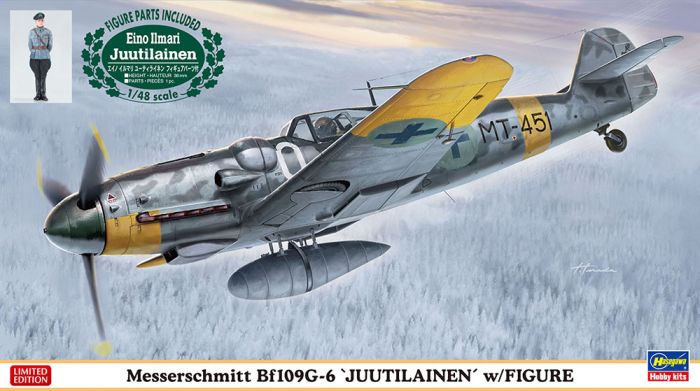
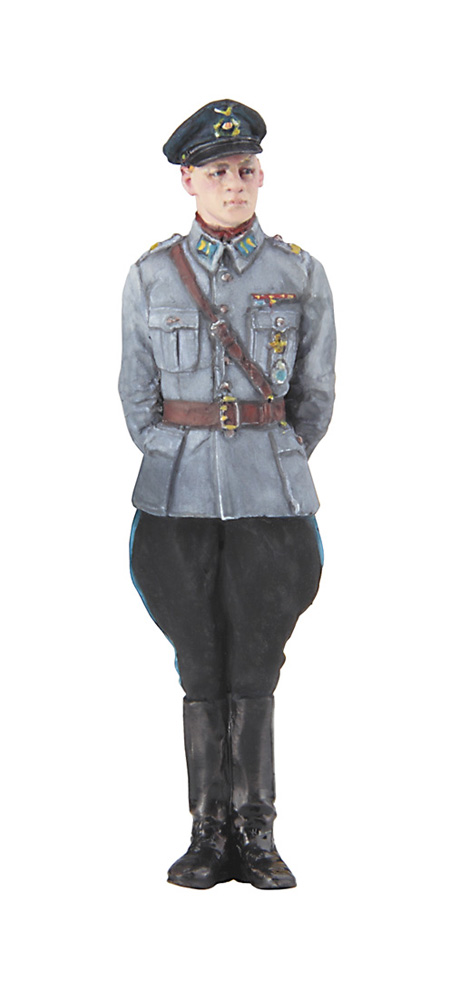
Hasegawa 1/48 Messerschmitt BF-109G-6 "JUUTILAINEN" with Figure # 07494
SKU
HAS07494
In Stock
Type:
1/48 Aircraft
EAN
4967834074941
Special Price
£44.99
was
£49.99
All Prices include VAT - Live stock levels & we offer eRewards
To collect in store, choose click & collect during checkout

Hasegawa 1/48 Messerschmitt BF-109G-6 "JUUTILAINEN" with Figure # 07494
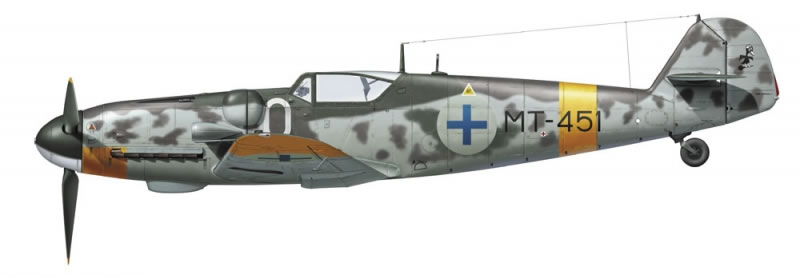
Markings
Finnish A.F. 1/LeLv 34 W.O. Eino Ilmari Juutilainen White O : MT-451 June 1944
The Messerschmitt Bf-109 is a single-engine German fighter jet with a metal frame and a traditional tail.
During World War II, it became the primary and most frequently produced Luftwaffe fighter.
The prototype flew to the air on May 29, 1935, and serial manufacture proceeded from 1936 to 1945.
It is estimated that around 35,000 Messerschmitt Bf-109 fighters were constructed in total, with many of them ending up in the Czech and Israeli air forces after the war.
The Bf-109's origins can be traced back to the Luftwaffe's announcement of a new fighter plane competition in 1933.
The Bf-109 project initially lost in competition with the He-112, but because of Willie Messerschmitt's intrigues, the project could be continued, and he eventually won the competition, becoming the Luftwaffe's primary fighter.
During the construction of the Bf-109, several major versions were produced.
The Bf-109B (Berta) was the first pre-production series, featuring various versions of the Junkers Jumo 210 (A or Da) engine.
They were put to the test in Spain during the Civil War in 1937.
The Bf-109C is the next version (Caesar).
They were equipped with a different engine than the B variant, as well as a large armament of two 20mm and two HP 7.92mm cannons.
These machines fought in Spain's skies as well.
The Bf-109D (Dora) is equipped with a Junkers Jumo 210 Da or Daimler-Benz DB 600 engine.
It saw action in the September campaign before being superseded by the E variant at the turn of the decade.
The Bf-109E (Emil) was the most famous model, powered by a Daimler-Benz 601A or N engine.
It was the first aircraft to use a three-blade propeller rather than a two-blade propeller.
The Bf-109E saw action over England, in North Africa, and on the Eastern Front during the French campaign.
Adolf Galland, the famed ace, began his career flying the Bf-109E.
The Bf-109F (Friedrich) is the following generation, which, according to German pilots, was the most aerodynamically flawless.
The fuselage, wings, and cabin fairings were all redesigned, but no new engine was installed.
It was put into service at the turn of the century, around 1940-1941.
Additional Bf-109 specifications were established as part of the design process, with the G (Gustav) version receiving the greatest number of copies.
The installation of a new 12-cylinder Daimler-Benz DB605A engine with 1475HP was the biggest major upgrade, improving the machine's performance.
The Bf-109armament G's consisted of two 13mm machine guns in the fuselage in front of the pilot's canopy, as well as a 20mm or larger MG151 30mm MK108 cannon.
The Bf-109K (Kurfirst) was the last mass-produced version, with manufacturing beginning in October 1944.
The engine was a Daimler-Benz DB 605DB or DC unit.
The Bf-109K was the fastest version of the Bf-109 built during WWII, attaining speeds of up to 730 km/h.
Aside from that, there were two versions - H and Z - but they were more experimental versions, and mass manufacturing did not begin until much later.
Following advancements in propulsion and weaponry, the Messerschmitt Bf-109 became one of the most dangerous fighters of World War II, demonstrating the great potential of Willi Messerschmitt's somewhat angular airframe.
Technical specifications (Bf-109 G-6):
Maximum speed: 640 km/h,
Climb speed: 17 m/s,
Maximum range: 850 km,
Maximum ceiling 12000m,
Armament:
Fixed - 2 MG131 13mm machine guns and 1 MG151 20mm cannon,
Suspended - 250 kg bombs,
or 2 Wfr missile launchers, length: 8.95 m, wingspan: 9.92 m, height: 2.6 m, maximum speed: 640 km/h, maximum range: 850 km,
| SKU | HAS07494 |
|---|---|
| Manufacturer | Hasegawa |
| Scale | 1/48 |
| EAN | 4967834074941 |
| Short Description | Hasegawa 1/48 Messerschmitt BF-109G-6 "JUUTILAINEN" with Figure # 07494 |
Option 1:
ROYAL MAIL TRACKED ® (Standard Parcel)

Orders under £10.00 will be charged: £3.95
Orders over the value of £10.00 are only: £4.99
Flat-rate pricing – no matter how large or small the order is!
-----------------------------------------------
Option 2:
EVRI (Tracking your parcel is easy)

Orders under £10.00 will be charged: £3.95
Orders over the value of £10.00 are only: £4.50
Evri Tracked 1–2 Days Delivery: £7.99
Flat-rate pricing – no matter how large or small the order is!
-----------------------------------------------
Option 3:
FEDEX (Next Day Delivery, Tracked & Insured)

All UK Next Day Delivery orders are only £8.95
Next Day delivery orders must be placed before 2:00pm.
This service does not deliver on a Saturday or Sunday. If you would like Saturday delivery, please call us on 01782 409310.
-----------------------------------------------
Option 4:
DPD EXPRESS PARCEL (Next Day Delivery, Tracked & Insured)

All UK Next Day Delivery orders are only £9.50
Next Day delivery orders must be placed before 2:00pm.
This service does not deliver on a Saturday or Sunday. If you would like Saturday delivery, please call us on 01782 409310.
-----------------------------------------------
Option 5:
Click & Collect from our Hobby Store

Please click here to view our contact details .

During checkout, you can select Collect from eModels (ST3 5BW) and this will exclude any shipping costs.
-----------------------------------------------
Option 6: Overseas Delivery Costs
All charges can easily be calculated prior to checkout.
Simply press the shopping basket button and select your country from the drop-down menu.
This service is shipped tracked, insured and fast express for your convenience.
For deliveries outside the UK, VAT of 20% will automatically be deducted from the price.
Import duty may be applied by the receiving country's customs.
We reserve the right to use whichever service we feel is most appropriate.
Please click here for our returns policy.
You might also like
-
 Hasegawa 1/48 Spitfire Mk VIII (Royal Air Force Fighter) # 09081Special Price £26.99 was £29.99
 -
 Hasegawa 1/48 Hughes OH-6D Akeno Special 2019 with Female SDF Official Figure # 07488Special Price £49.49 was £54.99


